Draw Climber
- 4.2
- Rating
- 100.00M
- Installs
- Free
- Price

 Analysis by App-foxy
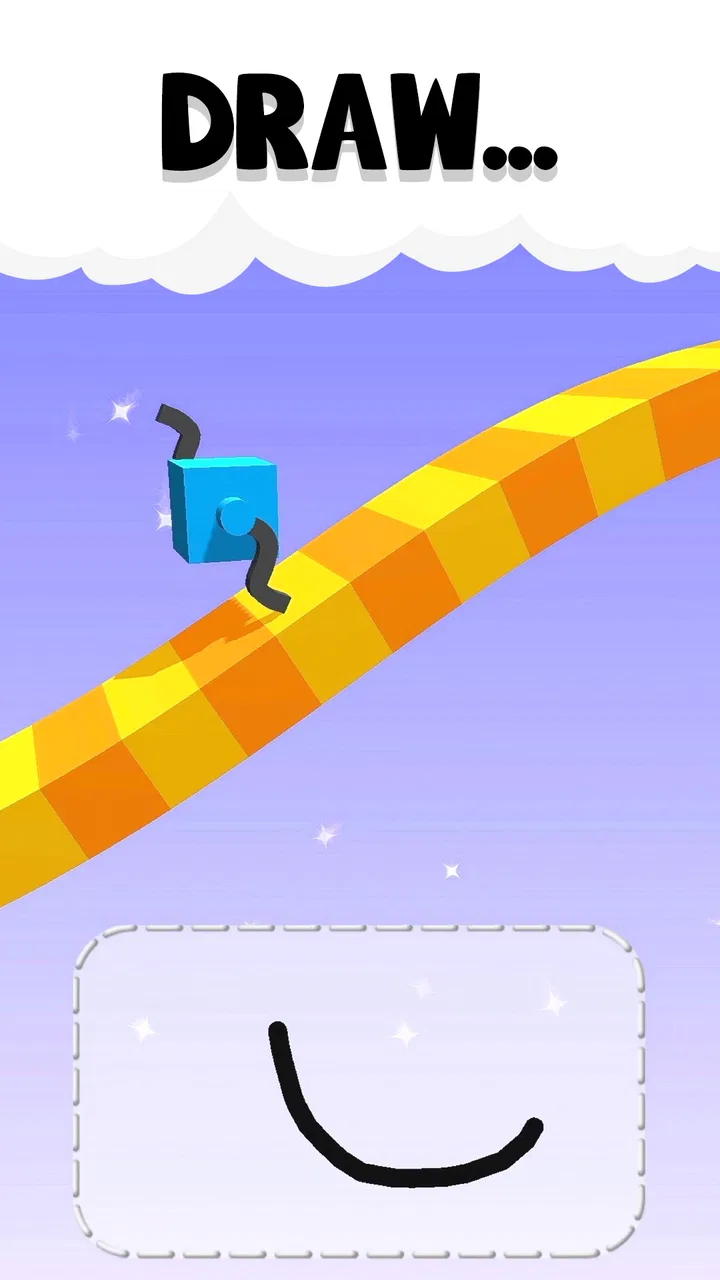
My first few minutes with Draw Climber were more revealing than I expected. The idea is immediately clear: I draw a pair of legs, place them on a small runner, and watch that shape try to carry the character through a race. It is a simple arcade game from VOODOO, but the simplicity is not empty. The drawing is the decision, the race is the feedback, and every mistake appears quickly on the screen.
That quick response gives the game its particular mood. I am not studying a complicated menu or learning a long list of controls. I am making a rough sketch, seeing how it behaves, and deciding whether the next attempt needs a taller shape, a wider shape, or something more compact. The presentation stays light and playful, which suits short sessions when I want something I can understand without preparation.
It is free to play and aimed at Everyone, so it is easy to approach as a casual family-friendly game. The large audience also makes sense: the store shows an average rating of 4.2 from around 366 thousand ratings, with more than 100 million installs. Those figures do not make it automatically perfect, but they do reflect how accessible the central idea is.
You May Also Like

 Blood Strike: 2.5 Anniversary
Blood Strike’s Loadouts Turn Every Drop Into a Tactical Gamble
A close look at Blood Strike’s custom loadouts: how fast access to signature weapons reshapes its battle royale rhythm, rewards preparation, and narrows the gap between fights.

 Pandora - Music & Podcasts
Pandora’s Music Is Easy to Start, but Harder to Recover
Pandora’s strength is its low-effort path from a seed to a station. Its weak spot is how much confidence it asks you to place in connection, setup, and quiet recovery.

 8 Ball Pool
 Is Built on Rivalries, Rematches, and Routine
A close look at the rivalries, rematches, shared routines, and unanswered safety questions that turn a quick pool match into a persistent mobile community.

 Samsung Music
’s Quiet Strength Is Playing What You Already Own
Its reach comes less from spectacle than from dependable access to a personal library. That simplicity is both the app’s strongest retention engine and its ceiling.

 AccuWeather: Weather Radar
AccuWeather Review: A Quick, Clear Forecast for Everyday Decisions
For everyday plans, the best forecast is the one you can understand quickly. AccuWeather makes rain timing, radar, and local conditions easy to act on, with a few trade-offs.

 Hill Climb Racing
Why Hill Climb Racing Still Turns Crashes Into One More Run
A tiny car, a bumpy hill and one more upgrade: Hill Climb Racing keeps resurfacing because its simple chaos makes every near-miss feel personal.
More From Our News Desk
View All News


How the visual world turns a sketch into a playable mood
I find the visual style works best when I treat each race as a small experiment rather than a miniature competition: the uncluttered presentation makes it easier to notice what my sketch changes, while the playful tone keeps a poor result from feeling like a setback. That clarity is useful, but it also puts more weight on the pace and feedback, which is where the game’s short-session rhythm becomes important.
A bright setting built around readable movement
The art direction is not trying to create a detailed world with a deep story. Instead, it gives the race a clean visual stage where the important question is always visible: is the drawn shape helping the runner move? The character, track, obstacles, and changing leg outline work together as pieces of a small visual experiment.
I like that the drawing itself remains the star. In many arcade games, decoration can make the screen busy and hide the reason for a failure. Here, the uncomplicated look supports the mechanic. When the runner catches on an edge or struggles to move forward, I can usually connect the result to the shape I made rather than searching through visual clutter.
That clarity also affects the game’s emotional tone. A failed attempt feels more amusing than dramatic because the legs are an improvised doodle, not a carefully animated vehicle. The game invites experimentation without making every mistake feel expensive. I can try an awkward design simply to see what it does, then redraw it immediately with a different idea.
Why the drawing screen matters more than it first appears
The drawing area is not just a novelty placed before a conventional race. It changes how I think about control. In a normal runner, I might tap to jump, switch lanes, or accelerate. Here, I make a physical-looking solution before the movement begins. The shape becomes a temporary control scheme, and its proportions influence the way the character handles the course.
A useful habit is to stop drawing only when the legs look attractive. A shape that seems balanced on paper may not be useful in motion. I get better results when I think about contact with the ground and the space available around obstacles. Longer strokes can help in open stretches, while a more compact design may be easier to manage when the course demands quick movement. The important point is to treat the sketch as a tool, not as a picture.
This is one of the game’s less obvious strengths: it turns a very basic input into a small design problem. I am not controlling every step, so preparation matters. That creates a satisfying pause between attempts, even though the overall pace remains quick.
The limits of the visual language
The same minimal style that makes the action readable can also make the experience feel repetitive over a longer sitting. Players looking for a rich setting, character development, or a strong narrative atmosphere will not find that here. The world is mainly a playful frame for the race, and it does not pretend to be more than that.
I also found that the visual simplicity places more pressure on the movement to stay interesting. When a run goes well, the clean presentation helps me focus. When several attempts feel similar, there are fewer environmental details to refresh my attention. That is not a serious flaw for a short arcade session, but it is a reason I would not choose this as my only game for a long journey.
Sound and rhythm keep the races approachable
The game’s mood depends heavily on timing. The race begins quickly, the result arrives quickly, and the next drawing is never far away. That rhythm makes the experience feel closer to a playful desk toy than to a demanding simulation. I can play for a brief break, fail once, and still feel that I have completed a small activity rather than interrupted a larger campaign.
The sound design supports that lightness instead of trying to make every movement feel grand. Audio cues help give the race a sense of motion and consequence, while the uncomplicated presentation keeps the mood cheerful. I would not describe the sound as the main reason to play, but it helps the visual feedback land with more personality than silent movement would.
There is a useful pacing trade-off here. Fast rounds reduce frustration because a poor design does not trap me for long. At the same time, the speed can encourage careless redrawing. I have had better results when I use the short pause before a new run to identify one specific problem rather than changing the entire design randomly.
For everyday play, that rhythm works particularly well. Imagine waiting for a friend at a café: I can start a race, make a quick adjustment, and put the phone down without needing to remember a complicated objective. On a longer commute, however, the repeated loop may need to be balanced with another game or activity if I prefer constant novelty.
When the mood works and when it does not
The cheerful style is a good match for players who enjoy harmless trial and error. It softens failure and makes unusual results entertaining. A badly shaped pair of legs can be funny because the game lets me see the consequences immediately, rather than hiding them behind a long loading sequence or a complicated explanation.
That approach may not suit someone who wants tension, atmosphere, or a strong sense of place. The setting is functional and the mood is intentionally light. If I want a game that builds suspense through story, detailed environments, or dramatic sound, I would look toward a different arcade experience. Draw Climber is more successful when judged as a compact visual challenge than as a world to explore.
Where the mechanics and presentation meet
The core mechanic fits the art direction because both are built around quick visual interpretation. I draw something, the game animates it, and I judge the result. There is very little distance between intention and feedback. That is important on a phone, where a touch-based idea works best when I can understand the outcome without memorizing controls.
The game also benefits from being a free arcade title rather than a long-form adventure. A short, repeatable structure makes the sketching mechanic easy to revisit. I do not need to remember a plot point or rebuild a complex strategy after a break. I simply return to the drawing and ask what shape might work better this time.
Still, the mechanic is not as precise as a traditional control system. My drawing can be interpreted as a physical solution, but I do not have the same fine control I would get from direct buttons or a virtual joystick. That uncertainty is part of the fun for casual players, yet it can frustrate anyone who wants exact, repeatable movement.
Practical drawing advice from repeated attempts
The most useful approach I found was to change one property at a time. If a run fails, I first consider whether the legs need more reach, more width, or a tighter shape. Replacing everything at once makes it difficult to learn from the result. A small adjustment turns each attempt into a clearer experiment.
I also avoid using the same design for every situation. A shape that performs well on a straightforward section may not be comfortable when the track becomes less forgiving. The game rewards flexibility more than loyalty to one favorite doodle. In that sense, the drawing stage is a tiny workshop: I am adapting a tool to the immediate challenge rather than searching for a universal answer.
Another practical point is to draw with the phone’s available space in mind. A rushed, cramped sketch can be harder to interpret and harder for me to evaluate afterward. Taking a moment to make the outline deliberate usually helps more than adding decorative detail. The aim is not to create the most elaborate legs; it is to create legs whose movement I can understand.
How it compares with familiar arcade alternatives
Compared with a standard endless runner, this game gives me more influence before the action starts and less direct control during the action. In an endless runner, success often depends on reaction speed and memorized timing. Here, the main decision happens in the drawing. That makes it a better fit for someone who enjoys tinkering with a solution rather than constantly tapping through hazards.
Compared with physics-based puzzle games, it is lighter and faster. Those games may offer more deliberate construction, more detailed rules, or more room for planning. Draw Climber keeps the construction step tiny, so it is easier to pick up but also less deep. I would choose it when I want an immediate experiment, not when I want to spend a long time engineering a single solution.
It also differs from traditional racing games. There is no emphasis on selecting a vehicle, learning a track in detail, or mastering a full control layout. The race is a test of the legs I have just drawn. That narrow focus is the reason the game feels approachable, but it is also why players seeking competitive racing depth may outgrow it.
Who should try it, and who should skip it
I would recommend it to players who enjoy quick arcade rounds, visual humor, and simple mechanics with a small creative twist. It is especially suitable for someone who wants a game that can be understood in moments and revisited without a long tutorial. The Everyone age rating also makes its tone broadly approachable.
I would be more cautious about recommending it to players who dislike repeated attempts or who need precise control at all times. The game’s charm comes from watching a drawn solution behave, and that behavior can feel unpredictable if I expect exact input-to-action correspondence. It is also not the best choice for anyone looking for a story-driven setting or a substantial progression system.
The free entry point makes trying it easy, while in-app purchases are listed at $2.99 per item. I would treat those purchases as optional rather than part of the reason to install. The main appeal is already present in the drawing-and-racing loop, so I would first decide whether that loop fits my habits before spending anything.
Device expectations and the current build
The game supports Android devices running version 8.0 or later, which covers a wide range of phones while still leaving older software behind. On a compatible device, the basic demands of the game are modest in spirit: the screen needs to show a clear sketch and a readable race, not a large open world.
The current version is 1.24. For someone deciding whether to install, the practical question is less about technical ambition and more about whether the phone can provide comfortable touch input. Because the drawing is central, a screen that feels cramped or a touch response that feels inconsistent can affect enjoyment more than visual performance would.
My final view of the atmosphere and the loop
What stays with me is the way the art, sound, and pacing all support the same promise: make a quick idea, watch it move, and learn from what happens. The setting is deliberately spare, but that restraint keeps attention on the sketch. The sound and short races give failures a soft landing, while the visual language makes the result easy to read.
Its limitations are equally clear. The world is not deep, the loop can become repetitive, and the drawing does not offer the precision of direct controls. Those are meaningful trade-offs, not problems I would hide. They explain why I see it as a strong casual arcade choice rather than a game for extended, demanding sessions.
For me, the best way to play is in small bursts: draw with a purpose, watch the movement, adjust one feature, and stop when the experiment stops feeling fresh. If that sounds appealing, VOODOO’s playful racer is worth trying. The real pleasure is not winning every race; it is discovering why one silly sketch works better than another.
FAQs for Draw Climber
01What is the main objective of Draw Climber?
Draw Climber is a unique puzzle game where the main objective is to draw legs for a cube to help it climb and navigate through various obstacles. The challenge lies in sketching the right shapes that will allow the cube to move efficiently and quickly through the course, aiming to reach the finish line first.
02Is Draw Climber free to play, and are there in-app purchases?
Yes, Draw Climber is free to download and play on both Android and iOS platforms. However, the game does offer in-app purchases. These purchases can enhance the gaming experience by unlocking features such as ad-free play, special items, or faster progression through levels.
03What are the key features of Draw Climber?
Draw Climber offers a variety of engaging features, including simple yet addictive gameplay, multiple levels with increasing difficulty, and customizable drawing options. The game also provides a competitive edge with leaderboards, allowing players to compare their progress with friends and other players globally.
04Does Draw Climber require an internet connection to play?
Draw Climber can be played offline, which means you can enjoy the game without an internet connection. However, certain features, such as leaderboard updates and in-app purchases, will require an internet connection to function properly.
05What age group is Draw Climber suitable for?
Draw Climber is designed for a wide audience and is suitable for players aged 4 and above. Its simple mechanics and colorful graphics make it appealing to children, while the strategic elements and increasing difficulty levels engage older players, ensuring fun for all ages.
Pros
- Simple and addictive gameplay mechanics.
- Smooth animations and vivid graphics.
- Creative level designs keep it fresh.
- Easy to learn
- hard to master experience.
- Frequent updates with new content.
Cons
- Can become repetitive over time.
- In-app purchases can be pricey.
- Occasional ad interruptions during play.
- Requires a stable internet connection.
- Limited customization options for climbers.

Draw Climber
Gallery